The Works of Art in Soul of Nation Were Made Between 1958 and 1983 During a Struggle for Liberation
The 1960s ignited a generation of activists fueled by inequity, unrest, and uprisings, and the art created during this time was a visual by-product of the nation's struggle toward equality. But the work of African American artists during this era remained in the shadows of the fine art earth, largely unrecognized by mainstream audiences.
In other words, the sustained inclusion of Black fine art in the historical canon is a boring, evolutionary process that was catalyzed by revolutionary acts.
This radical cultural free energy is the focus in "Soul of a Nation: Art in the Historic period of Black Power 1963-1983," which has just arrived at the Wide in Los Angeles. The bear witness examines the work of 60 artists and explores the historical and cultural influences that ascertain their unique approaches to Black art both as a vehicle for alter and an expression of self-exploration.

Installation view of "Soul of a Nation: Art in the Historic period of Black Ability 1963-1983" at the Wide, 2019. Photo by Pablo Enriquez, courtesy the Wide.
Since its debut at the Tate Modern, and throughout its subsequent appearances at the Crystal Bridges Museum in Arkansas and the Brooklyn Museum in New York, the show has been the discipline of much praise. One specific thing the L.A. incarnation reinforces is the essential function of a sense of collectivity to counteract Black artists' invisibility and exclusion from the mainstream art earth.
This is not a bear witness nigh defining or explaining Blackness art, abstractly. The artists here responded to shifting cultural tides in dramatically divergent ways. Rather it shines a critical light on the vital piece of work created by marginalized artists—and, chiefly, the networks that sustained them. Collectives became important access points into powerful networks of cultural activists and allies that included politicians, collectors, entertainers, and scholars who aligned to fight for racial equality and justice.
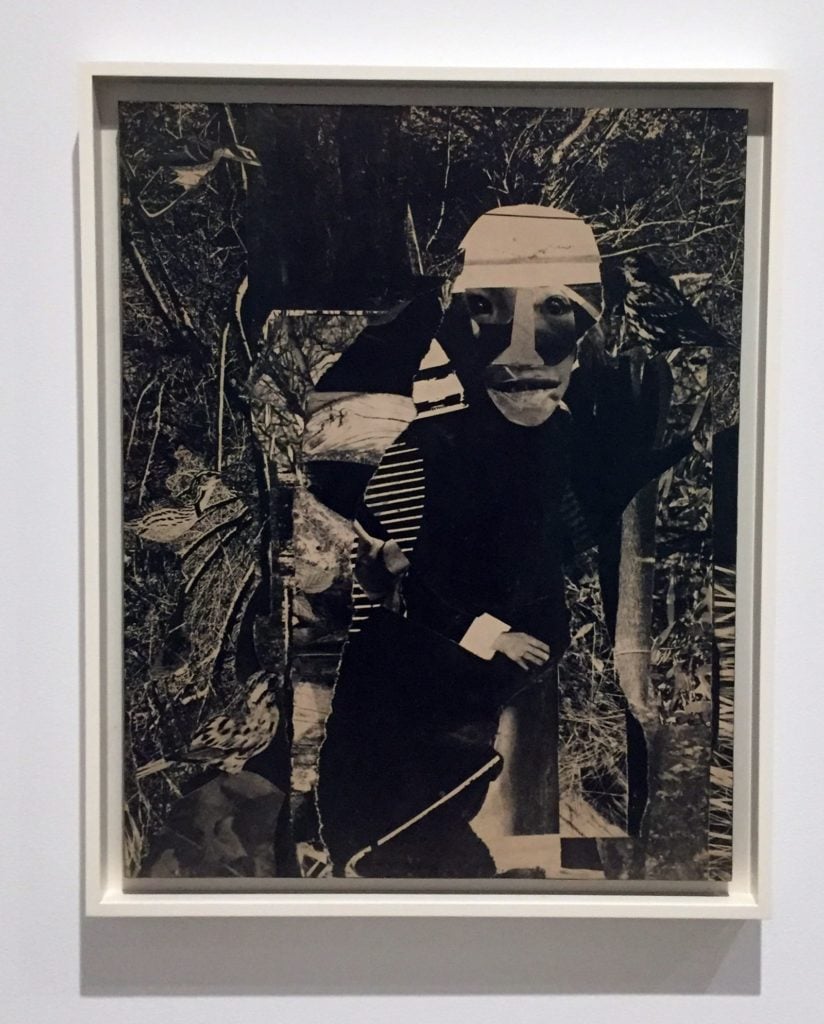
Romare Bearden, The Conjur Adult female (1964). Photo by Colony Little, courtesy of Michael Rosenfeld Gallery LLC, New York.
"Soul of a Nation" guides viewers through a variety of piece of work created by regional collectives from beyond the land. These include New York'due south Spiral, whose 1964 show titled "Works in Black in White" featured thematic and stylistically divergent works from Romare Bearden, Jacob Lawrence, and Emma Amos that wryly reflected the futility of defining Black art through binary parameters.
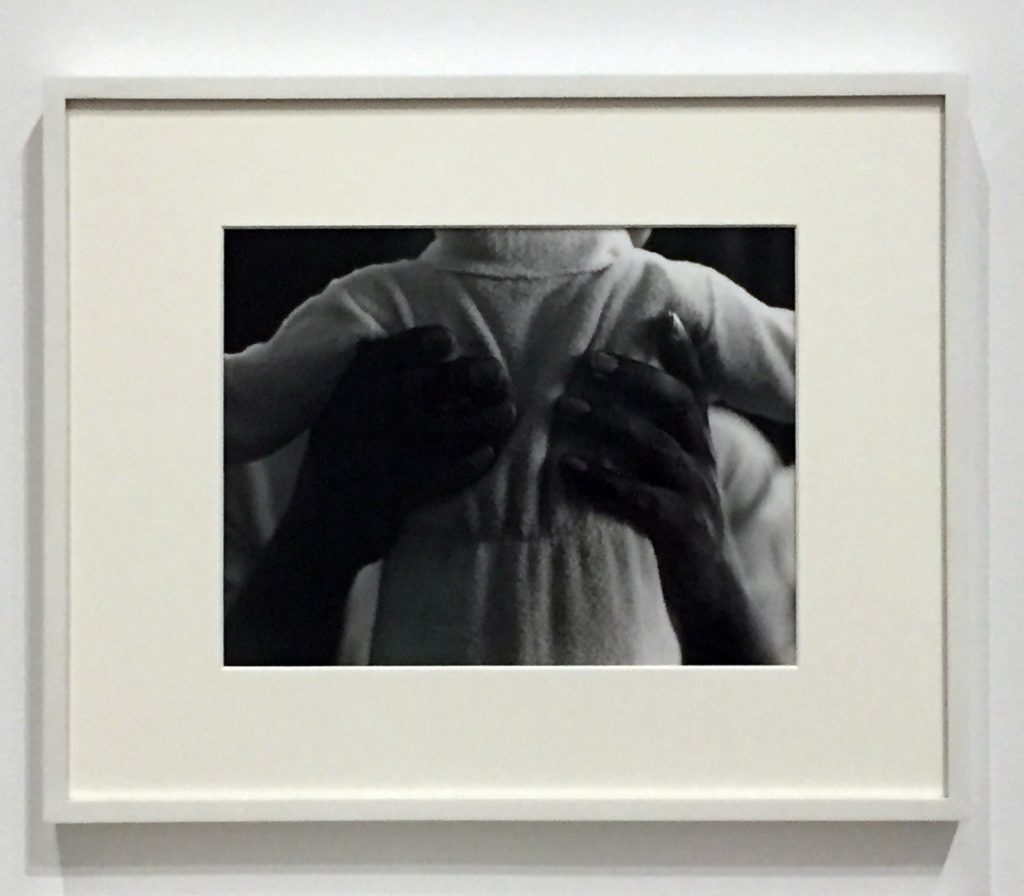
Roy DeCarava, Bill and Son, New York (1962). Photograph courtesy Colony Niggling
Emotionally evocative photography past members of the Kamoinge Workshop is thoughtfully represented. Likewise based in New York, Kamoinge was a collective formed in 1963 to nurture, mentor, and promote Black photographers who were excluded from both commercial and fine art photography. Here, the collective'southward work is thoughtfully represented, particularly in a robust presentation of piece of work by its original managing director Roy DeCarava.
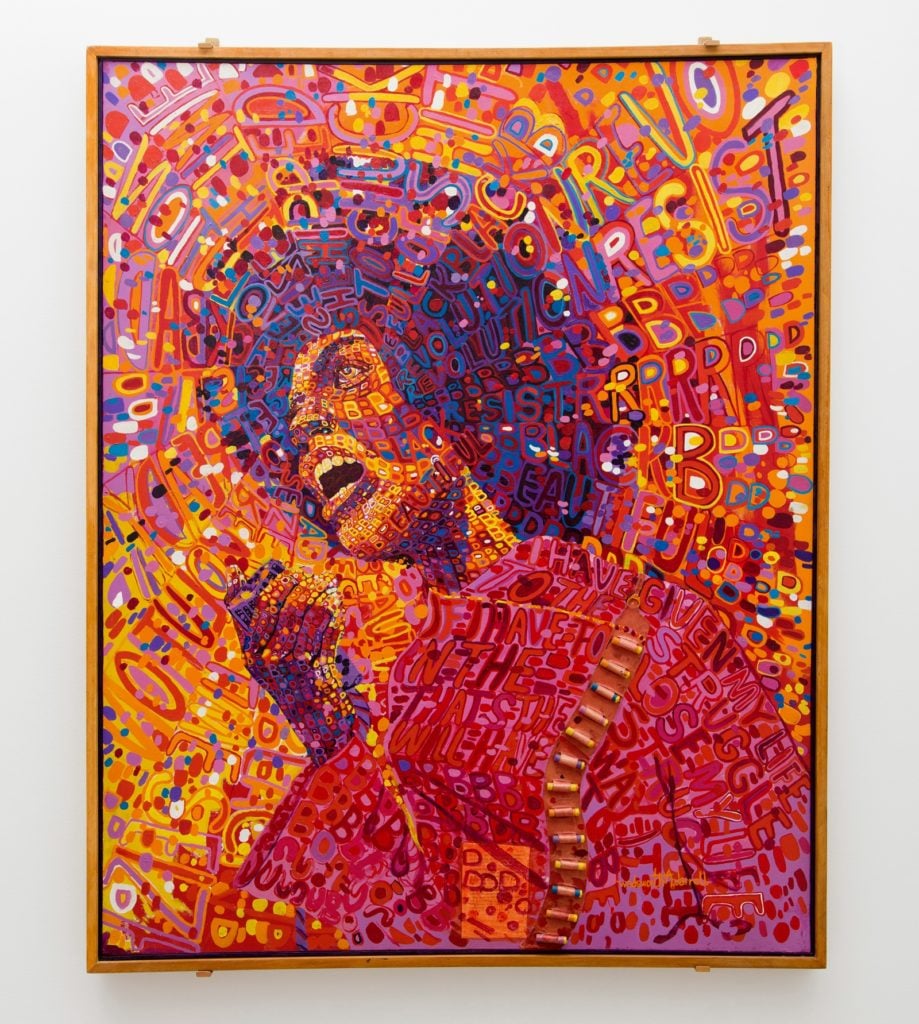
Wadsworth Jarrell, Revolutionary (Angela Davis) (1971). Photo courtesy Pablo Enriquez, courtesy the Broad.
Elsewhere, bold printmaking, painting, and style are the colorful standouts in a gallery space dedicated to Chicago'southward AfriCOBRA artists.
But the Wide'southward iteration of "Soul of a Nation" offered curators a unique opportunity to put an L.A. spin on the testify, making slight curatorial adjustments that distinguish it from its debut at the Tate Modern or its Crystal Bridges and Brooklyn Museum versions. I gallery space, for example, is dedicated to Betye Saar's beginning solo show at the California State University, Los Angeles'due south Fine Arts Gallery in 1973.
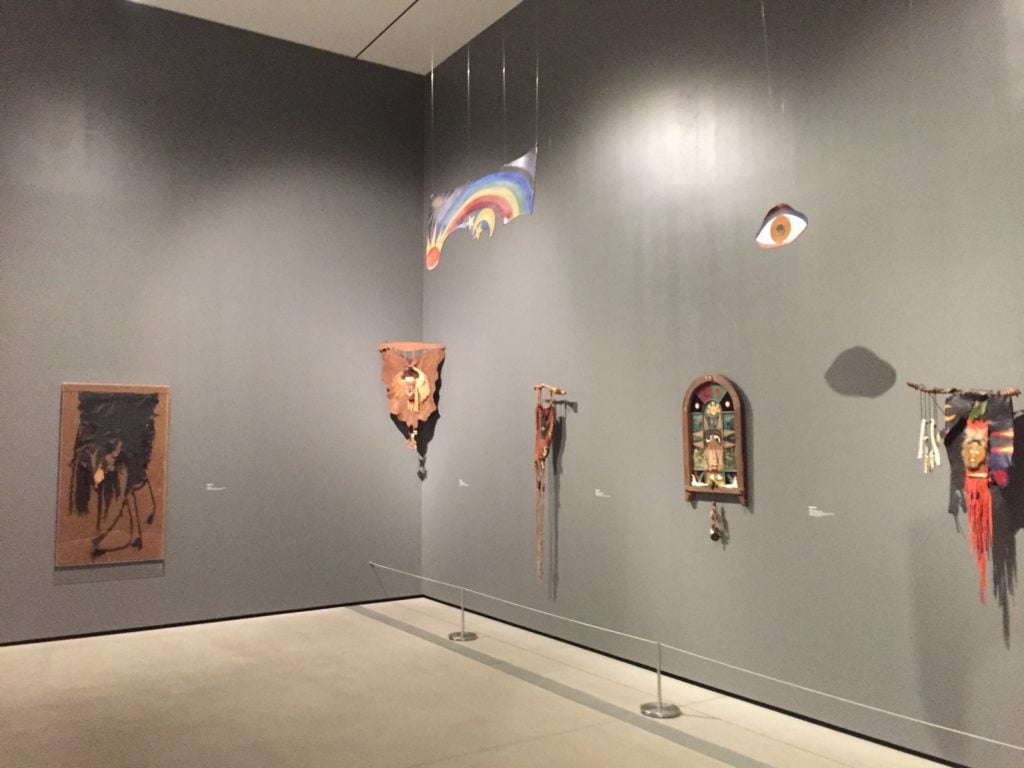
Installation view of works by Betye Saar in "Soul of a Nation: Art in the Age of Black Power 1963–1983" at the Wide, 2019. Photo courtesy Colony Fiddling.
The Wide's associate curator Sarah Loyer worked closely with Saar to recreate the original exhibition, correct down to the wall color: the dark, smoky grayness paint allows Saar'due south leather-clad mixed-media assemblages of Native American tribal talismans, Hoodoo shrines, and Mojo numberless to pop off the wall. This item series of installations, made from bones, twigs, beads, and other ephemera, ushered in a new wave of Saar's work that centered on memory and the mysteries contained in plant objects.
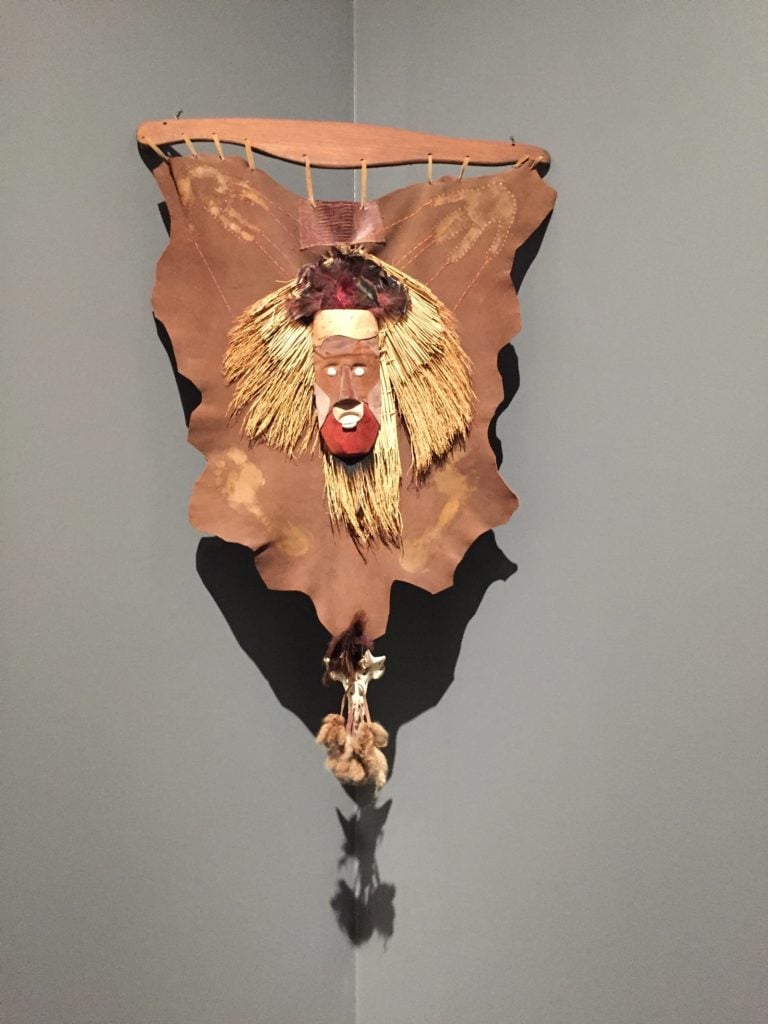
Betye Saar, Eshu (The Trickster) ,1971. Photo courtesy Colony Little.
Saar explored these themes concurrently in ii iconic works, shown here in another gallery, this one dedicated to California assemblage. These works reclaim and transform imagery establish in derogatory black memorabilia. The Liberation of Aunt Jemima (1972) and I've Got Rhythm (1972) are overt proclamations of reclaimed power.
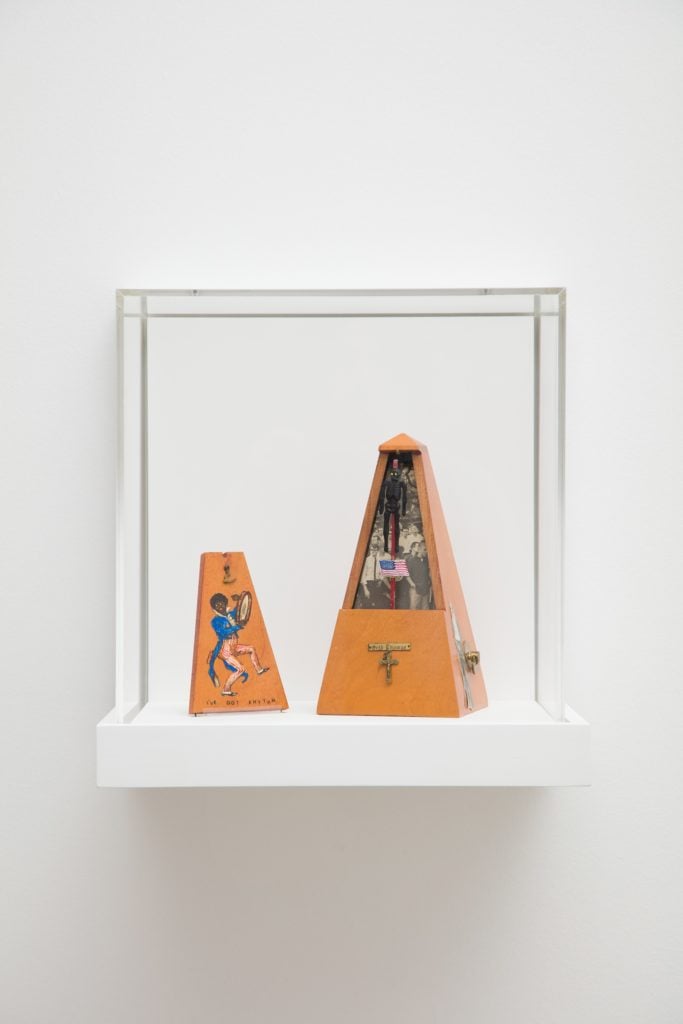
Betye Saar, I've Got Rhythm (1972). Photo courtesy Pablo Enriquez, courtesy the Broad.
Here, such pieces by Saar are placed amid subtler notwithstanding equally resonant expressions of protest: In Some Bright Morning (1963), sculptor Melvin Edwards uses welded metallic car parts, chains, and spikes in an abstracted meditation on the barbarous history of lynchings. While its title references the lynching of Eli Cooper in 1919, it'south besides linked to incidents of racial violence between the 1950s and early on 1960s reported in Black journals like the Liberator and Freedomways.
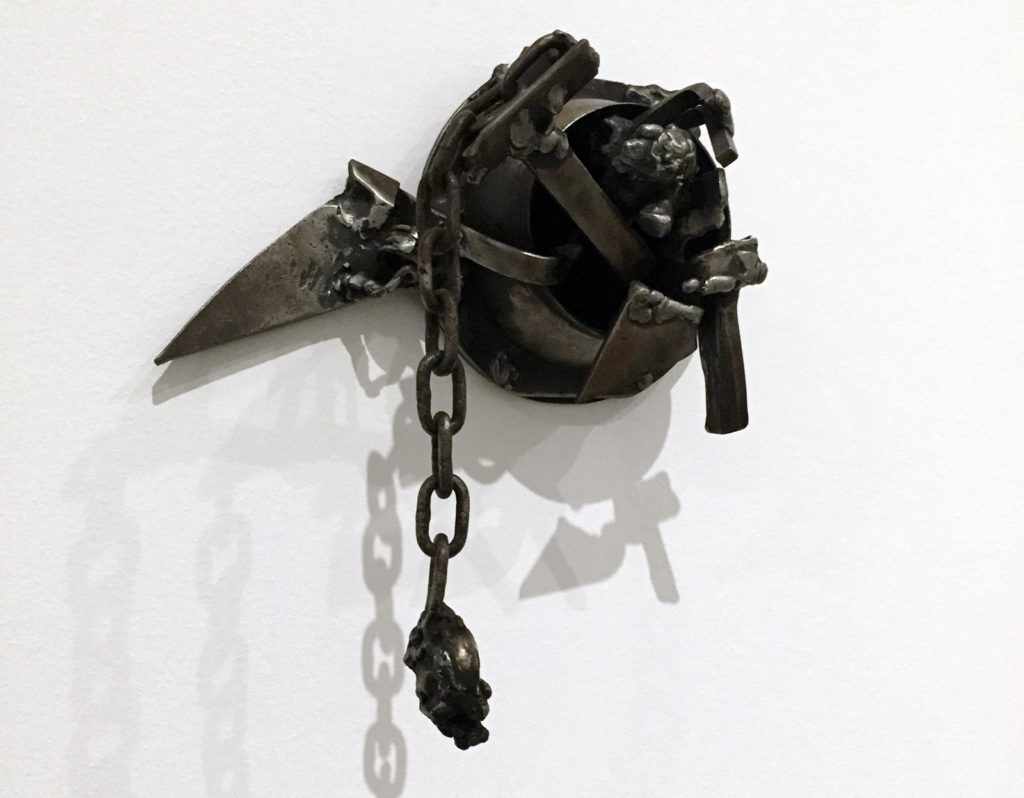
Melvin Edwards, Some Bright Morn (1963). Photo past Colony Little.
The small-scale sculpture is ane of iii "Lynch Fragments" by Edwards that explore various themes of brutality, resistance, rebirth, and renewal. These powerful assemblage installations—along with others by Daniel LaRue Johnson, John Outterbridge, and Noah Purifoy—use found objects that tell one story and build new narratives, and the Broad show'due south installation lets y'all see how they play off one another.
Prior to the 1960s, Los Angeles had a long history of both individual and popular efforts that focused on institutions that were slow to make progress on multifariousness and inclusion amongst artists in their collections, their exhibitions, and their community. The fruits of these long-term efforts began to manifest in the late '60s and early on '70s.
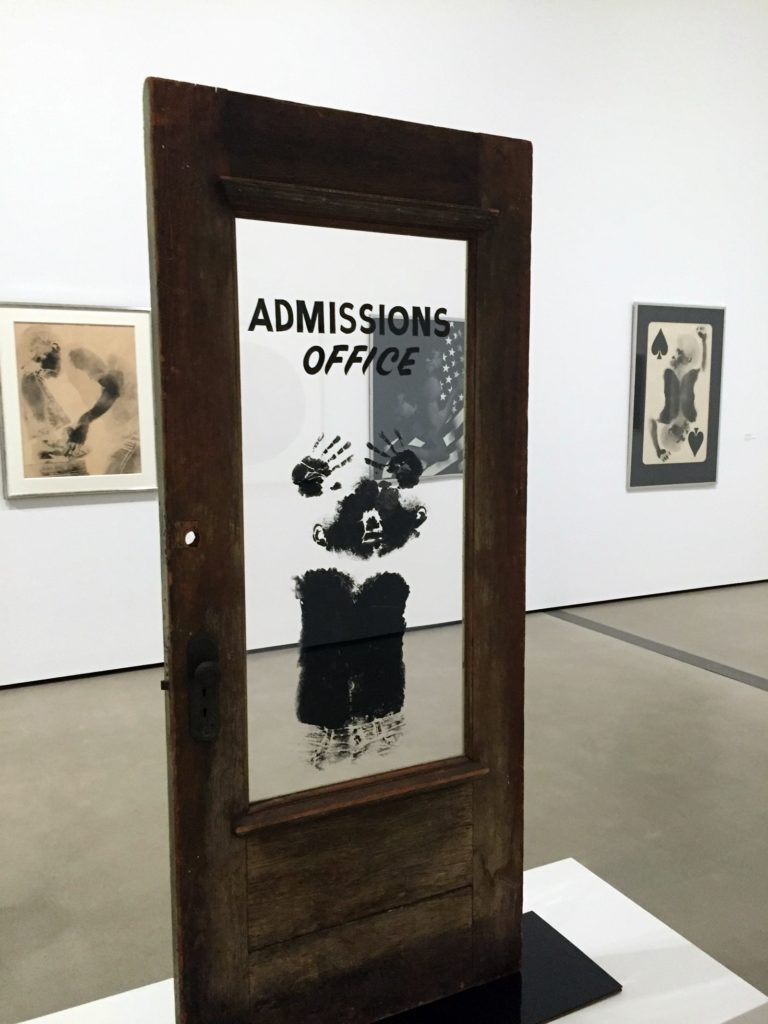
Installation view of piece of work past David Hammons in the "3 Graphic Artists" section of "Soul of a Nation: Fine art in the Age of Black Power 1963–1983." Photo courtesy Colony Little
At the Broad, curators Zoe Whitley and Mark Godfrey take recreated elements of a 1971 LACMA exhibition titled "Iii Graphic Artists." That show was born out of a grassroots campaign led by 2 LACMA preparators who had dedicated themselves to improving representation and access for African Americans at the museum. Equally a result of their advancement, the Blackness Arts Quango (BAC) was formed in 1968.
The combination of the networked activism of the BAC and Charles White's art world gravitas rallied the back up of collectors, entertainers, writers, and scholars to promote Black artists at LACMA. The show the museum organized in response, "Three Graphic Artists," paired piece of work by Charles White with two "emerging" artists of the time: David Hammons and Timothy Washington.
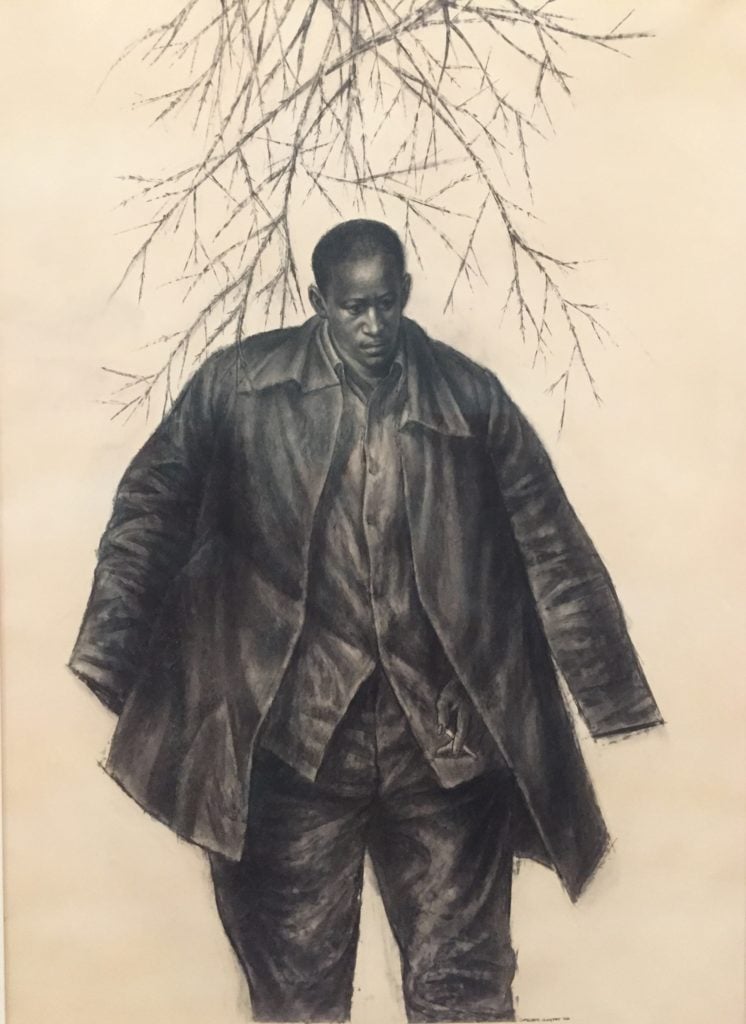
Charles White, J'Charge! No. 5 (1966). Photo by Colony Little, courtesy of Michael Rosenfeld Gallery LLC, New York.
Nevertheless, behind the scenes, "3 Graphic Artists" as well proved that despite a shared mission, very real divisions and discord lingered: The 1971 show opened among protests past members of the BAC who wanted to encounter Charles White featured in a solo, named bear witness. As frustration grew over LACMA's wearisome progress in hiring and promoting Black staff into curatorial positions—essential linchpins for promoting diversity within exhibitions and its drove—leading members of the Black Arts Council eventually shifted their focus away from LACMA, opting to create and promote institutions defended to African American art.
This shift in energy laid the groundwork for the cosmos of the California African American Museum in 1977. CAAM is the largest institutional lender in the Broad's iteration of "Soul of a Nation," making this evidence's arrival in California a kind of return abode.
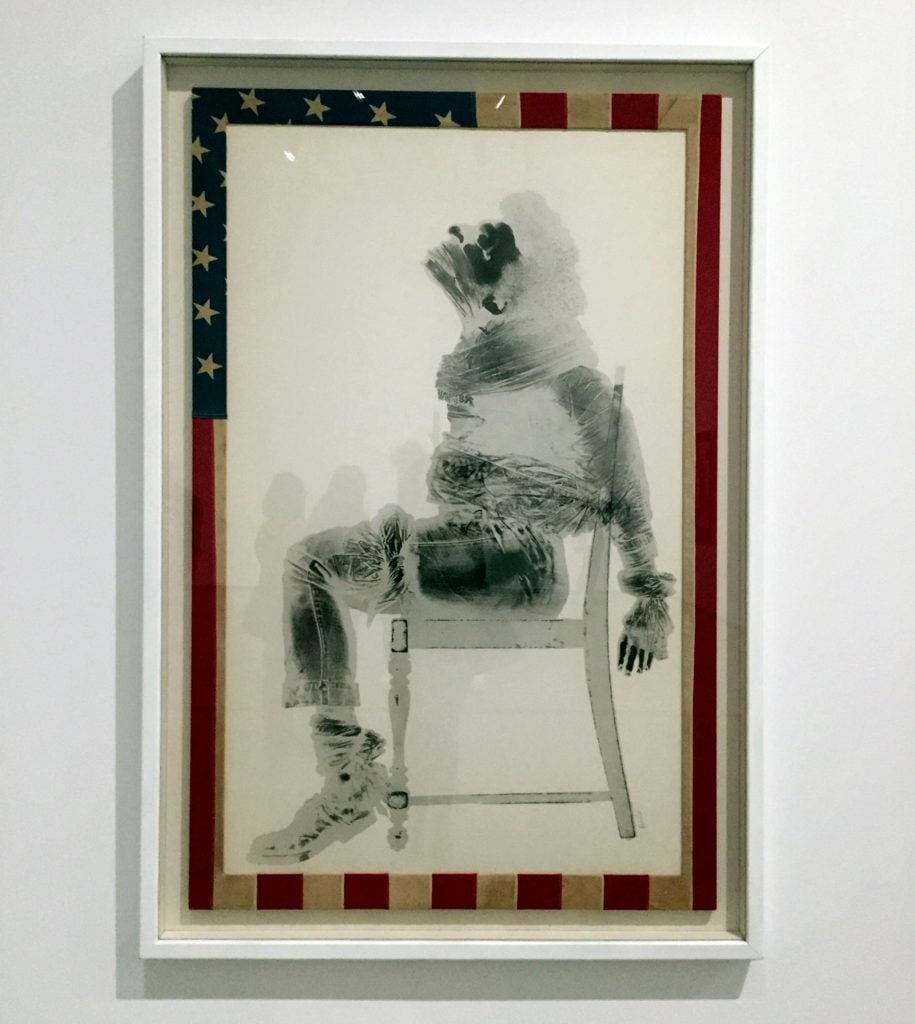
David Hammons, Injustice Case (1971). Photo past Colony Little.
The section of "Soul of a Nation" dedicated to recreating "3 Graphic Artists" features a serial of David Hammons'southward seminal trunk prints, including The Door (Admissions Office) (1969) and Spade (Power for the Spade) (1969), shown with Charles White's J'Charge (1966). The presence of these item works get timely reminders of present-day headlines about privilege in higher education and inequality in justice that continue to dominate the news cycle. The work offers fresh indictments on our slow evolution toward progress and reform.
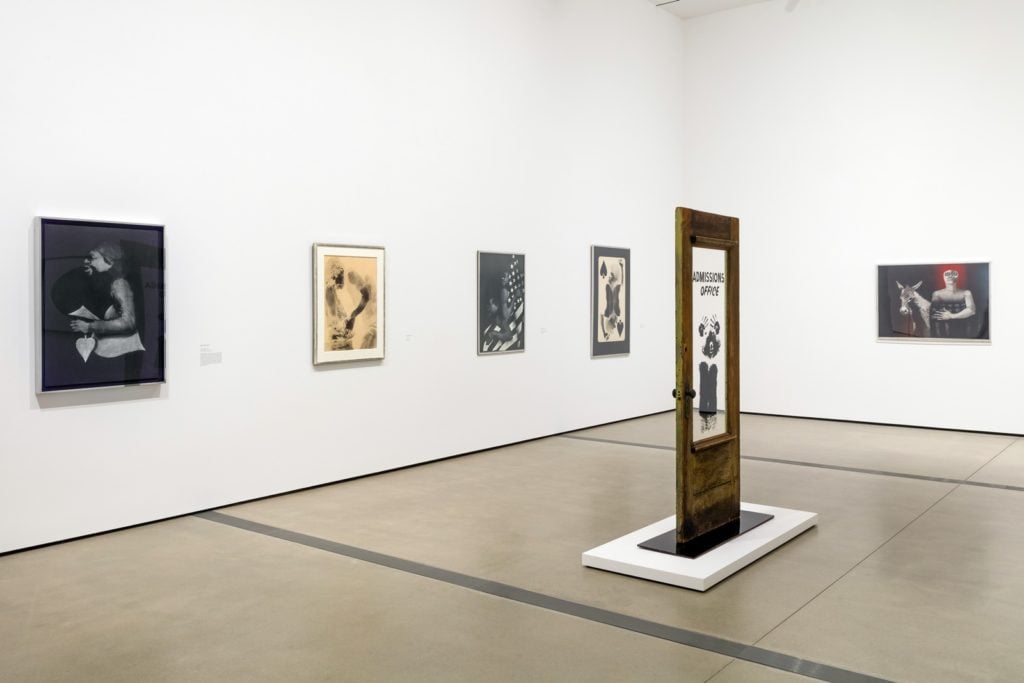
Recreation of "3 Graphic Artists" in "Soul of a Nation: Art in the Age of Blackness Ability 1963-1983" at the Wide, 2019. Photo by Pablo Enriquez, courtesy the Wide.
Overall, "Soul of a Nation" provides its viewers with an important, critical expect at the fine art created during tumultuous times and its role in American history. In her book South of Pico, Dr. Kellie Jones cites a 1977 New York Times interview of curator David C. Driskell where he laments our compulsion to define "Black art" as a style instead of as a social construct that bears farther examination: "I retrieve it'southward a sociological concept. I don't recall information technology's annihilation stylistic. Nosotros don't go around saying white art, only I think it's very of import for us to go along maxim black art until it becomes recognized every bit American art."
At the Broad, the dynamic stylistic range of artistic responses to the question of what "Blackness art" means only underscores the importance and relevance of this show—non but for understanding the by but for agreement this present moment too. It gives today's audiences a strong statement for inclusion and for the urgency of continued, sustainable progress toward equity.
"Soul of a Nation: Art in the Age of Blackness Ability 1963–1983" is on view at the Wide Museum, Los Angeles, March 23–September 1, 2019.
Follow Artnet News on Facebook:
Want to stay alee of the art world? Subscribe to our newsletter to become the breaking news, middle-opening interviews, and incisive critical takes that drive the chat forrad.
Source: https://news.artnet.com/art-world/soul-of-a-nation-broad-museum-review-1509094
0 Response to "The Works of Art in Soul of Nation Were Made Between 1958 and 1983 During a Struggle for Liberation"
Post a Comment