Digestive System of a Beef Cow
Ruminant livestock include cattle, sheep, and goats. Ruminants are hoofed mammals that have a unique digestive system that allows them to better apply energy from fibrous found textile than other herbivores. Dissimilar monogastrics such as swine and poultry, ruminants have a digestive system designed to ferment feedstuffs and provide precursors for energy for the animal to use. By better understanding how the digestive system of the ruminant works, livestock producers can amend empathize how to intendance for and feed ruminant animals.
Ruminant Digestive Anatomy and Role
The ruminant digestive organisation uniquely qualifies ruminant animals such as cattle to efficiently use high roughage feedstuffs, including forages. Anatomy of the ruminant digestive organization includes the mouth, natural language, salivary glands (producing saliva for buffering rumen pH), esophagus, four-compartment stomach (rumen, reticulum, omasum, and abomasum), pancreas, gall bladder, small intestine (duodenum, jejunum, and ileum), and big intestine (cecum, colon, and rectum).
A ruminant uses its oral cavity (oral cavity) and tongue to harvest forages during grazing or to consume harvested feedstuffs. Cattle harvest forages during grazing by wrapping their tongues around the plants and then pulling to tear the provender for consumption. On average, cattle take from 25,000 to more than than 40,000 prehensile bites to harvest provender while grazing each day. They typically spend more than one-third of their fourth dimension grazing, one-tertiary of their time ruminating (cud chewing), and slightly less than one-third of their fourth dimension idling where they are, neither grazing nor ruminating.
The roof of the ruminant mouth is a hard/soft palate without incisors. The lower jaw incisors work against this hard dental pad. The incisors of grass/roughage selectors are wide with a shovel-shaped crown, while those of concentrate selectors are narrower and chisel-shaped. Premolars and molars match between upper and lower jaws. These teeth shell and grind plant material during initial chewing and rumination.
Saliva aids in chewing and swallowing, contains enzymes for breakdown of fatty (salivary lipase) and starch (salivary amylase), and is involved in nitrogen recycling to the rumen. Saliva'due south most important function is to buffer pH levels in the reticulum and rumen. A mature moo-cow produces up to l quarts of saliva per day, but this varies, depending on the amount of time spent chewing feed, because that stimulates saliva production.
Forage and feed mixes with saliva containing sodium, potassium, phosphate, bicarbonate, and urea when consumed, to course a bolus. That bolus then moves from the rima oris to the reticulum through a tube-like passage called the esophagus. Muscle contractions and pressure differences carry these substances downward the esophagus to the reticulum.

Ruminants eat speedily, swallowing much of their feedstuffs without chewing it sufficiently (< ane.5 inches). The esophagus functions bidirectionally in ruminants, allowing them to regurgitate their cud for further chewing, if necessary. The procedure of rumination or "chewing the cud" is where fodder and other feedstuffs are forced dorsum to the mouth for further chewing and mixing with saliva. This cud is so swallowed once more and passed into the reticulum. And so the solid portion slowly moves into the rumen for fermentation, while most of the liquid portion chop-chop moves from the reticulorumen into the omasum and then abomasum. The solid portion left behind in the rumen typically remains for up to 48 hours and forms a dense mat in the rumen, where microbes can utilise the fibrous feedstuffs to make precursors for free energy.
True ruminants, such as cattle, sheep, goats, deer, and antelope, have i stomach with four compartments: the rumen, reticulum, omasum, and abomasums. The ruminant stomach occupies nigh 75 percentage of the abdominal cavity, filling nearly all of the left side and extending significantly into the right side. The relative size of the four compartments is as follows: the rumen and reticulum contain 84 percent of the book of the total stomach, the omasum 12 percentage, and the abomasum 4 percentage. The rumen is the largest stomach compartment, holding up to 40 gallons in a mature cow.

The reticulum holds approximately 5 gallons in the mature cow. Typically, the rumen and reticulum are considered i organ because they take similar functions and are separated only past a minor muscular fold of tissue. They are collectively referred to equally the reticulorumen. The omasum and abomasum hold upwards to xv and 7 gallons, respectively, in the mature cow.
The reticulorumen is home to a population of microorganisms (microbes or "rumen bugs") that include bacteria, protozoa, and fungi. These microbes ferment and interruption down plant jail cell walls into their carbohydrate fractions and produce volatile fatty acids (VFAs), such as acetate (used for fatty synthesis), priopionate (used for glucose synthesis), and butyrate from these carbohydrates. The brute afterward uses these VFAs for energy.
The reticulum is called the "honeycomb" because of the honeycomb advent of its lining. It sits underneath and toward the forepart of the rumen, lying against the diaphragm. Ingesta period freely betwixt the reticulum and rumen. The main function of the reticulum is to collect smaller digesta particles and move them into the omasum, while the larger particles remain in the rumen for farther digestion.

The reticulum also traps and collects heavy/dense objects the beast consumes. When a ruminant consumes a nail, wire, or other sharp heavy object, information technology is very likely the object will be defenseless in the reticulum. During normal digestive tract contractions, this object tin penetrate the reticulum wall and make its way to the heart, where it can lead to hardware disease. The reticulum is sometimes referred to every bit the "hardware stomach." Hardware illness is discussed in particular in Mississippi State Academy Extension Publication 2519 Beef Cattle Nutritional Disorders.

The rumen is sometimes called the "paunch." Information technology is lined with papillae for food absorption and divided past muscular pillars into the dorsal, ventral, caudodorsal, and caudoventral sacs. The rumen acts every bit a fermentation vat by hosting microbial fermentation. About 50 to 65 per centum of starch and soluble sugar consumed is digested in the rumen. Rumen microorganisms (primarily bacteria) digest cellulose from plant cell walls, assimilate complex starch, synthesize protein from nonprotein nitrogen, and synthesize B vitamins and vitamin G. Rumen pH typically ranges from 6.v to 6.8. The rumen environment is anaerobic (without oxygen). Gases produced in the rumen include carbon dioxide, methane, and hydrogen sulfide. The gas fraction rises to the elevation of the rumen above the liquid fraction.

The omasum is spherical and connected to the reticulum by a short tunnel. It is called the "many piles" or the "butcher's bible" in reference to the many folds or leaves that resemble pages of a volume. These folds increase the surface area, which increases the area that absorbs nutrients from feed and h2o. Water absorption occurs in the omasum. Cattle accept a highly developed, large omasum.
The abomasum is the "truthful stomach" of a ruminant. Information technology is the compartment that is near similar to a stomach in a nonruminant. The abomasum produces hydrochloric acid and digestive enzymes, such as pepsin (breaks down proteins), and receives digestive enzymes secreted from the pancreas, such as pancreatic lipase (breaks downward fats). These secretions help prepare proteins for absorption in the intestines. The pH in the abomasum by and large ranges from 3.5 to 4.0. The main cells in the abomasum secrete mucous to protect the abomasal wall from acid damage.
The small and large intestines follow the abomasum equally further sites of food absorption. The pocket-sized intestine is a tube upward to 150 feet long with a 20-gallon chapters in a mature cow. Digesta entering the small intestine mix with secretions from the pancreas and liver, which elevate the pH from two.five to between 7 and 8. This higher pH is needed for enzymes in the modest intestine to work properly. Bile from the gall bladder is secreted into the first section of the small intestine, the duodenum, to assist in digestion. Active nutrient absorption occurs throughout the small intestine, including rumen featherbed protein absorption. The intestinal wall contains numerous "finger-like" projections called villi that increase abdominal surface surface area to aid in nutrient absorption. Muscular contractions aid in mixing digesta and moving it to the next section.
The large intestine absorbs water from material passing through it then excretes the remaining material as feces from the rectum. The cecum is a large blind pouch at the kickoff of the large intestine, approximately iii feet long with a 2-gallon capacity in the mature moo-cow. The cecum serves little part in a ruminant, unlike its role in horses. The colon is the site of most of the h2o absorption in the large intestine.
Ruminant Digestive Development
Immature ruminants, such as young, growing calves from birth to well-nigh ii to 3 months of historic period, are functionally nonruminants. The reticular groove (sometimes referred to as esophageal groove) in these young animals is formed past muscular folds of the reticulum. It shunts milk directly to the omasum and then abomasum, bypassing the reticulorumen. The rumen in these animals must be inoculated with rumen microorganisms, including bacteria, fungi, and protozoa. This is thought to exist accomplished through mature ruminants licking calves and environmental contact with these microorganisms.
Immature ruminants must undergo reticulorumen-omasal growth, including increases in book and musculus. In a calf at birth, the abomasum is the largest compartment of the stomach, making upwardly more than l per centum of the total stomach area. The reticulorumen and omasum account for 35 percent and 14 percentage of the total stomach area in the newborn calf. Equally ruminants develop, the reticulorumen and omasum grow apace and account for increasing proportions of the total stomach area. In mature cattle, the abomasum encompasses only 21 pct of the total breadbasket capacity, whereas the reticulorumen and omasum make upwards 62 and 24 pct, respectively, of the total tummy area. Rumen papillae (sites of nutrient absorption) lengthen and subtract in numbers as part of rumen evolution.
Because immature ruminants do not have a functional rumen, feeding recommendations differ for developing ruminants compared with adult ruminants. For instance, it is recommended immature ruminants are not immune admission to feeds containing non-poly peptide nitrogen such as urea. Developing ruminants are as well more sensitive to gossypol and dietary fat levels than mature ruminants. Design nutritional programs for ruminants because animal age.

Ruminant Feeding Types
Based on the diets they adopt, ruminants can exist classified into distinct feeding types: concentrate selectors, grass/roughage eaters, and intermediate types. The relative sizes of various digestive organization organs differ by ruminant feeding type, creating differences in feeding adaptations. Knowledge of grazing preferences and adaptations amongst ruminant livestock species helps in planning grazing systems for each private species and too for multiple species grazed together or on the same acreage.
Concentrate selectors have a small reticulorumen in relation to body size and selectively scan trees and shrubs. Deer and giraffes are examples of concentrate selectors. Animals in this group of ruminants select plants and plant parts high in easily digestible, nutrient dense substances such as found starch, protein, and fat. For example, deer adopt legumes over grasses. Concentrate selectors are very express in their power to digest the fibers and cellulose in plant cell walls.
Grass/roughage eaters (majority and roughage eaters) include cattle and sheep. These ruminants depend on diets of grasses and other fibrous plant material. They prefer diets of fresh grasses over legumes merely tin adequately manage rapidly fermenting feedstuffs. Grass/roughage eaters have much longer intestines relative to trunk length and a shorter proportion of large intestine to pocket-sized intestine every bit compared with concentrate selectors.
Goats are classified as intermediate types and prefer forbs and browse such as woody, shrubby type plants. This grouping of ruminants has adaptations of both concentrate selectors and grass/roughage eaters. They have a fair though limited capacity to digest cellulose in found cell walls.
Carbohydrate Digestion
Forages
On loftier-provender diets ruminants oft ruminate or regurgitate ingested forage. This allows them to "chew their cud" to reduce particle size and improve digestibility. As ruminants are transitioned to higher concentrate (grain-based) diets, they ruminate less.
Once inside the reticulorumen, fodder is exposed to a unique population of microbes that begin to ferment and assimilate the establish cell wall components and break these components downwardly into carbohydrates and sugars. Rumen microbes use carbohydrates along with ammonia and amino acids to grow. The microbes ferment sugars to produce VFAs (acetate, propionate, butyrate), methane, hydrogen sulfide, and carbon dioxide. The VFAs are and then captivated across the rumen wall, where they go to the liver.
Once at the liver, the VFAs are converted to glucose via gluconeogenesis. Because plant jail cell walls are slow to assimilate, this acid production is very deadening. Coupled with routine rumination (chewing and rechewing of the cud) that increases salivary flow, this makes for a rather stable pH environment (around half-dozen).
Loftier-Concentrate Feedstuffs (Grains)
When ruminants are fed high-grain or concentrate rations, the digestion procedure is similar to forage digestion, with a few exceptions. Typically, on a high-grain nutrition, in that location is less chewing and ruminating, which leads to less salivary product and buffering agents' existence produced. Additionally, virtually grains have a high concentration of readily digestible carbohydrates, unlike the more than structural carbohydrates found in institute jail cell walls. This readily digestible saccharide is rapidly digested, resulting in an increase in VFA product.
The relative concentrations of the VFAs are also changed, with propionate being produced in the greatest quantity, followed past acetate and butyrate. Less methane and oestrus are produced as well. The increment in VFA product leads to a more acidic surround (pH 5.5). It also causes a shift in the microbial population by decreasing the forage using microbial population and potentially leading to a subtract in digestibility of forages.
Lactic acid, a potent acid, is a byproduct of starch fermentation. Lactic acrid production, coupled with the increased VFA product, can overwhelm the ruminant's ability to buffer and absorb these acids and lead to metabolic acidosis. The acidic surroundings leads to tissue damage within the rumen and can pb to ulcerations of the rumen wall. Take care to provide adequate forage and avoid situations that might pb to acidosis when feeding ruminants loftier-concentrate diets. Acidosis is discussed in detail in Mississippi Land University Extension Service Publication 2519 Beef Cattle Nutritional Disorders. In addition, energy equally a nutrient in ruminant diets is discussed in detail in Mississippi Land University Extension Service Publication 2504 Energy in Beef Cattle Diets.
Protein Digestion
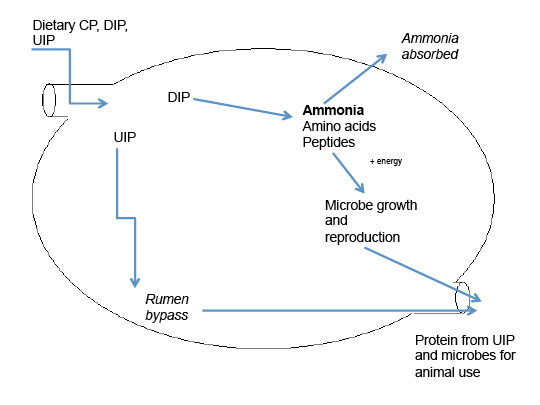
Ii sources of poly peptide are available for the ruminant to apply: protein from feed and microbial protein from the microbes that inhabit its rumen. A ruminant is unique in that it has a symbiotic relationship with these microbes. Like other living creatures, these microbes have requirements for protein and energy to facilitate growth and reproduction. During digestive contractions, some of these microorganisms are "washed" out of the rumen into the abomasum where they are digested similar other proteins, thereby creating a source of protein for the animal.
All crude protein (CP) the beast ingests is divided into two fractions, degradable intake protein (DIP) and undegradable intake protein (UIP, also called "rumen bypass poly peptide"). Each feedstuff (such equally cottonseed meal, soybean hulls, and annual ryegrass forage) has different proportions of each poly peptide blazon. Rumen microbes suspension downwardly the DIP into ammonia (NH3) amino acids, and peptides, which are used by the microbes forth with energy from carbohydrate digestion for growth and reproduction.
Excess ammonia is absorbed via the rumen wall and converted into urea in the liver, where it returns in the blood to the saliva or is excreted by the body. Urea toxicity comes from overfeeding urea to ruminants. Ingested urea is immediately degraded to ammonia in the rumen.
When more ammonia than free energy is available for building protein from the nitrogen supplied by urea, the backlog ammonia is absorbed through the rumen wall. Toxicity occurs when the excess ammonia overwhelms the liver's ability to detoxify it into urea. This tin can impale the fauna. Notwithstanding, with sufficient energy, microbes use ammonia and amino acids to grow and reproduce.
The rumen does not degrade the UIP component of feedstuffs. The UIP "bypasses" the rumen and makes its way from the omasum to the abomasum. In the abomasum, the ruminant uses UIP along with microorganisms washed out of the rumen as a protein source. Protein as a nutrient in ruminant diets is discussed in particular in Mississippi Land University Extension Service Publication 2499 Poly peptide in Beef Cattle Diets.
Importance of Ruminant Livestock
The digestive system of ruminants optimizes use of rumen microbe fermentation products. This adaptation lets ruminants apply resources (such every bit high-fiber provender) that cannot be used by or are not available to other animals. Ruminants are in a unique position of being able to use such resource that are not in demand by humans just in plough provide man with a vital food source. Ruminants are also useful in converting vast renewable resource from pasture into other products for human employ such equally hides, fertilizer, and other inedible products (such every bit horns and bone).
One of the all-time ways to meliorate agricultural sustainability is past developing and using effective ruminant livestock grazing systems. More 60 percent of the land area in the world is too poor or erodible for cultivation but tin go productive when used for ruminant grazing. Ruminant livestock can use land for grazing that would otherwise not be suitable for crop production. Ruminant livestock product too complements crop product, because ruminants can utilize the byproducts of these crop systems that are not in need for human employ or consumption. Developing a adept understanding of ruminant digestive beefcake and role can assist livestock producers better programme appropriate nutritional programs and properly manage ruminant animals in diverse production systems.
References
Church building, D. C. ed. 1993. The Ruminant Fauna Digestive Physiology and Nutrition. Waveland Printing, Inc. Prospect Heights, IL.
Oltjen, J. Westward., and J. 50. Beckett. 1996. Role of ruminant livestock in sustainable agronomical systems. J. Anim. Sci. 74:1406-1409.
Parish, J. A., M. A. McCann, R. H. Watson, N. N. Paiva, C. South. Hoveland, A. H. Parks, B. L. Upchurch, N. South. Colina, and J. H. Bouton. 2003. Utilize of non-ergot alkaloid-producing endophytes for alleviating tall fescue toxicosis in stocker cattle. J. Anim. Sci. 81:2856-2868.
Van Soest, P. J. 1987. Nutritional Ecology of the Ruminant. Cornell University Press. Ithaca, NY.
Publication 2503 (POD-12-17)
By Jane A. Parish, PhD, Professor and Head, N Mississippi Research and Extension Center; J. Daniel Rivera, PhD, Acquaintance Extension/Enquiry Professor, Southward Mississippi Co-operative Experiment Station; and Holly T. Boland, PhD, former Assistant Research/Extension Professor, Animal and Dairy Sciences. Photos of ruminant digestive arrangement courtesy of Stephanie R. Hill, PhD, former Assistant Research Professor, Animal and Dairy Sciences.
Copyright 2017 by Mississippi State Academy. All rights reserved. This publication may exist copied and distributed without amending for nonprofit educational purposes provided that credit is given to the Mississippi State University Extension Service.
Produced past Agricultural Communications.
Mississippi State University is an equal opportunity institution. Discrimination in academy employment, programs, or activities based on race, color, ethnicity, sex, pregnancy, religion, national origin, disability, age, sexual orientation, genetic information, condition every bit a U.S. veteran, or any other status protected by applicable police is prohibited. Questions about equal opportunity programs or compliance should exist directed to the Part of Compliance and Integrity, 56 Morgan Artery, P.O. 6044, Mississippi Land, MS 39762, (662) 325-5839.
Extension Service of Mississippi State Academy, cooperating with U.Due south. Section of Agriculture. Published in furtherance of Acts of Congress, May eight and June 30, 1914. GARY B. JACKSON, Director
Source: https://extension.msstate.edu/publications/publications/understanding-the-ruminant-animal-digestive-system
0 Response to "Digestive System of a Beef Cow"
Post a Comment