Y Tho Reddit Baby Looking Through Prism Glass
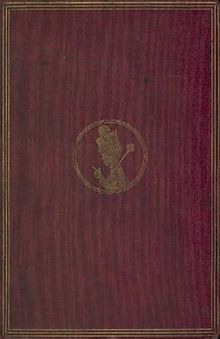 Commencement edition comprehend of Through the Looking-Glass | |
| Author | Lewis Carroll |
|---|---|
| Illustrator | John Tenniel |
| State | United Kingdom |
| Linguistic communication | English |
| Genre | Children'south fiction |
| Publisher | Macmillan |
| Publication date | 27 Dec 1871 (dated 1872) |
| Pages | 208 |
| Preceded by | Alice'south Adventures in Wonderland |
Through the Looking-Drinking glass, and What Alice Found There (also known equally Alice Through the Looking-Glass or just Through the Looking-Glass ) is a novel published on 27 December 1871 (though indicated as 1872)[1] by Lewis Carroll and the sequel to Alice'due south Adventures in Wonderland (1865). Alice again enters a fantastical world, this time by climbing through a mirror into the globe that she tin can meet beyond it. There she finds that, just like a reflection, everything is reversed, including logic (for example, running helps i remain stationary, walking abroad from something brings one towards it, chessmen are alive, plant nursery rhyme characters exist, and and then on).
Through the Looking-Glass includes such verses equally "Jabberwocky" and "The Walrus and the Carpenter", and the episode involving Tweedledum and Tweedledee. The mirror above the fireplace that is displayed at Hetton Lawn in Charlton Kings, Gloucestershire (a business firm that was owned by Alice Liddell's grandparents, and was regularly visited by Alice and Lewis Carroll) resembles the one drawn by John Tenniel and is cited as a possible inspiration for Carroll.[2]
It was the first of the "Alice" stories to gain widespread popularity, and prompted a newfound appreciation for its predecessor when information technology was published.[3]
Plot summary [edit]
Affiliate Ane – Looking-Drinking glass House: Alice is playing with a white kitten (whom she calls "Snowdrop") and a black kitten (whom she calls "Kitty") when she ponders what the world is like on the other side of a mirror'south reflection. Climbing up onto the fireplace mantel, she pokes at the wall-hung mirror behind the fireplace and discovers, to her surprise, that she is able to footstep through it to an alternative world. In this reflected version of her ain house, she finds a book with looking-glass verse, "Jabberwocky", whose reversed printing she can read only by holding it upwardly to the mirror. She besides observes that the chess pieces have come to life, though they remain pocket-size enough for her to selection upwardly.

Alice entering the looking-drinking glass.
Chapter Two – The Garden of Live Flowers: Upon leaving the house (where it had been a cold, snowy nighttime), she enters a sunny leap garden where the flowers can speak; they perceive Alice as beingness a "flower that can move nigh". Elsewhere in the garden, Alice meets the Ruby Queen, who is now human-sized, and who impresses Alice with her power to run at breathtaking speeds.
Chapter 3 – Looking-Glass Insects: The Ruby Queen reveals to Alice that the entire countryside is laid out in squares, like a gigantic chessboard, and offers to brand Alice a queen if she can move all the fashion to the eighth rank/row in a chess lucifer. Alice is placed in the second rank as one of the White Queen's pawns, and begins her journeying across the chessboard by boarding a railroad train that jumps over the 3rd row and directly into the quaternary rank, thus acting on the rule that pawns can advance two spaces on their start movement. She arrives in a forest where a depressed gnat teaches her about the looking glass insects, strange creatures part bug part object (due east.m., bread and butterfly, rocking horse wing), before flying away sadly. Alice continues her journey and forth the style, crosses the "forest where things have no names". At that place she forgets all nouns, including her own proper name. With the help of a fawn who has also forgotten his identity, she makes information technology to the other side, where they both remember everything. Realizing that he is a fawn, she is a human being, and that fawns are afraid of humans, it runs off (to Alice's frustration).
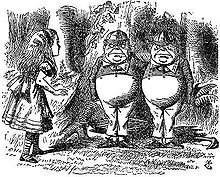
Alice coming together Tweedledum (centre) and Tweedledee (right)
Chapter 4 – Tweedledum and Tweedledee: She then meets the fatty twin brothers Tweedledum and Tweedledee, whom she knows from the plant nursery rhyme. After reciting the long verse form "The Walrus and the Carpenter", they describe Alice's attention to the Red King—loudly snoring away under a nearby tree—and maliciously provoke her with idle philosophical banter that she exists only equally an imaginary figure in the Red King's dreams. Finally, the brothers brainstorm suiting up for battle, only to exist frightened away by an enormous crow, every bit the nursery rhyme about them predicts.

Chapter V – Wool and Water: Alice side by side meets the White Queen, who is very absent-minded but boasts of (and demonstrates) her ability to remember future events earlier they have happened. Alice and the White Queen accelerate into the chessboard's fifth rank by crossing over a brook together, simply at the very moment of the crossing, the Queen transforms into a talking Sheep in a small-scale store. Alice soon finds herself struggling to handle the oars of a small rowboat, where the Sheep annoys her with (seemingly) nonsensical shouting about "venereal" and "feathers".
Chapter Half-dozen – Humpty Dumpty: After crossing yet another brook into the sixth rank, Alice immediately encounters Humpty Dumpty, who, besides celebrating his unbirthday, provides his own translation of the strange terms in "Jabberwocky". In the procedure, he introduces Alice to the concept of portmanteau words, earlier his inevitable fall.
Affiliate 7 – The Lion and the Unicorn: "All the king's horses and all the king's men" come to Humpty Dumpty's assistance, and are accompanied by the White Male monarch, along with the Lion and the Unicorn, who again proceed to act out a nursery rhyme by fighting with each other. In this chapter, the March Hare and Hatter of the first book make a brief re-advent in the guise of "Anglo-Saxon messengers" called "Haigha" and "Hatta".
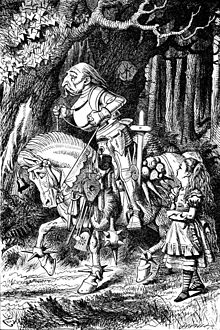
Chapter Eight – "Information technology's my ain Invention": Upon leaving the Lion and Unicorn to their fight, Alice reaches the seventh rank by crossing some other brook into the forested territory of the Cherry-red Knight, who is intent on capturing the "white pawn"—Alice—until the White Knight comes to her rescue. Escorting her through the forest towards the concluding brook-crossing, the Knight recites a long poem of his own composition chosen Haddocks' Eyes, and repeatedly falls off his horse.
Chapter Nine – Queen Alice: Bidding cheerio to the White Knight, Alice steps across the last brook, and is automatically crowned a queen, with the crown materialising abruptly on her head (a reference to pawn promotion). She presently finds herself in the company of both the White and Crimson Queens, who relentlessly confound Alice by using word play to thwart her attempts at logical word. They then invite one another to a political party that will be hosted by the newly crowned Alice—of which Alice herself had no prior knowledge.
Chapter Ten – Shaking: Alice arrives and seats herself at her own party, which quickly turns into chaos. Alice finally grabs the Red Queen, assertive her to be responsible for all the day'south nonsense, and begins shaking her.
Chapter 11 – Waking: Alice awakes in her armchair to discover herself holding the black kitten, who she deduces to take been the Reddish Queen all along, with the white kitten having been the White Queen.
Chapter Twelve – Which dreamed it?: The story ends with Alice recalling the speculation of the Tweedle brothers, that everything may have been a dream of the Carmine King, and that Alice might herself be no more than a figment of his imagination. The book ends with the line "Life, what is it but a dream?"
Characters [edit]
Main characters [edit]
- Alice
- March Hare
- The Hatter
- Humpty Dumpty
- Red Rex
- Red Queen
- The Sheep
- Tweedledum and Tweedledee
- The Walrus and the Carpenter
- White King
- White Knight
- White Queen
- The Lion and the Unicorn
Pocket-sized characters [edit]
Symbolism [edit]
Mirrors [edit]
Ane of the key motifs of Through the Looking-Glass is that of mirrors, including the utilise of opposites, time running backwards, and and so on, not to mention the championship of the book itself. In fact, the themes and settings of the book get in somewhat of a mirror image to its predecessor, Alice'southward Adventures in Wonderland (1865). The start book begins in the warm outdoors, on four May;[a] uses frequent changes in size as a plot device; and draws on the imagery of playing cards. The second book, even so, opens indoors on a snowy, wintry night exactly 6 months later, on 4 Nov (the day earlier Guy Fawkes Night);[b] uses frequent changes in fourth dimension and spatial directions as a plot device; and draws on the imagery of chess.
Chess [edit]

Lewis Carroll's diagram of the story as a chess game

The composition, according to Glen Downey
While the first Alice novel took playing cards as a theme, Through the Looking-Glass instead used chess; most of the master characters are represented by chess pieces, with Alice beingness a pawn. The looking-drinking glass earth consists of foursquare fields divided by brooks or streams, and the crossing of each brook typically signifies a modify in scene, with Alice advancing one square. At the book'due south outset, Carroll provided and explained a chess composition with descriptive notation, respective to the events of the story. Although the slice movements follow the rules of chess, other basic rules are ignored: i role player (White) makes several consecutive moves while the (Ruby-red/Black) opponent's moves are skipped, and a late bank check (12... Qe8+) is left undealt with. Carroll also explained that sure items listed in the limerick practice not accept corresponding piece moves but only refer to the story, e.g. the "castling of the three Queens, which is merely a way of saying that they entered the palace". Despite these liberties, the final position is an authentic checkmate.
The near extensive treatment of the chess motif in Carroll's novel was fabricated past Glen Downey in his primary's thesis, later expanded and incorporated into his dissertation on the use of chess as a device in Victorian fiction. In the erstwhile slice, Downey gave the composition's moves in algebraic notation: ane... Qh5 2. d4 3. Qc4 4. Qc5 five. d5 6. Qf8 7. d6 viii. Qc8 9. d7 Ne7+ 10. Nxe7 xi. Nf5 12. d8=Q Qe8+ 13. Qa6 14. Qxe8#.[iv] In the latter piece, Downey treated the 21 items in the composition sequentially, identifying the in a higher place 16 coherent chess moves, and another five items equally "non-moves" or pure story descriptors, per Carroll'southward qualification.[5]
The mating position nearly satisfies the weather of a pure mate, a special blazon of checkmate where the mated king is prevented from moving to whatever of the adjacent squares in its field by exactly one enemy assail, amongst other conditions. The position is also nearly an ideal mate, a stronger form of pure mate in which every piece on the lath of either color contributes to the checkmate. The one characteristic of the position which prevents it from being either a pure or an ideal mate is that the Red (Black) Rex is unable to motion to e3 for two reasons: the knight'south attack, and the (sustained) set on of the newly promoted, mating queen. Although pure and ideal mates are "incidental" in real games, they are objects of aesthetic interest to composers of chess problems.[half-dozen]
Language [edit]
The White Queen offers to hire Alice equally her lady's maid and to pay her "twopence a week, and jam every other day." Alice says that she doesn't desire any jam today, to which the Queen replies, "you couldn't have it if you did want it. The rule is, jam tomorrow and jam yesterday—merely never jam to-day." This is a reference to the rule in Latin that the word iam or jam—which means now, in the sense of already or at that time—cannot be used to depict now in the present, which is nunc in Latin. Therefore, "jam" is never available today.[7] This exchange is as well a demonstration of the logical fallacy of equivocation.[eight]
Poems and songs [edit]
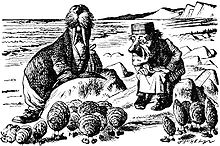
Well-nigh poems and songs of the book do not include a title.
- "Introduction" (prelude; "Child of the pure unclouded brow…")
- "Jabberwocky"[c] [9] : 31–34, chap.I
- "Tweedledum and Tweedledee"[9] : 74, chap.IV
- "The Walrus and the Carpenter"[d] [9] : 77–82, chap.IV
- "Humpty Dumpty"[ix] : 115, chap.Vi
- Humpty Dumpty'south poem ("In Winter when the fields are white…")[ix] : 128–xxx, chap.VI
- "The Lion and the Unicorn"[nine] : 141, chap.VII
- "Haddocks' Eyes" (i.due east., "A-sitting on a Gate")[9] : 171–3, chap.Nine
- Red Queen's lullaby ("Hush-a-past lady, in Alice's lap…")[9] : 187, chap.10
- "To the Looking-Glass world it was Alice that said…"[9] : 192, chap.Ten
- White Queen'south riddle ("'Starting time, the fish must exist defenseless'…")[nine] : 197, chap.Ten
- "A boat beneath a sunny heaven"(postlude; acrostic poem in which putting the commencement letters of each line spell Alice Pleasance Liddell, the girl after whom the book'due south Alice is named[10]).[ix] : 210–11
The Wasp in a Wig [edit]
Lewis Carroll decided to suppress a scene involving what was described equally "a wasp in a wig" (perhaps a play on the commonplace expression "bee in the bonnet"). A biography of Carroll, written by Carroll's nephew, Stuart Dodgson Collingwood, suggests that one of the reasons for this suppression was a suggestion from his illustrator, John Tenniel,[11] who wrote in a alphabetic character to Carroll dated 1 June 1870:[12]
I am spring to say that the 'wasp' affiliate doesn't interest me in the to the lowest degree, and I can't encounter my way to a picture. If you desire to shorten the volume, I can't help thinking – with all submission – that there is your opportunity.
For many years, no i had whatsoever idea what this missing department was or whether it had survived. In 1974, a document purporting to be the galley proofs of the missing section was auctioned at Sotheby's; the catalogue description, in office, read, "the proofs were bought at the sale of the writer'due south…personal effects…Oxford, 1898." The document would exist won by John Fleming, a Manhattan book dealer, for a bid of almost U.s.a.$832 (equivalent to $iv,366 in 2020).[thirteen] The contents were subsequently published in Martin Gardner'due south More Annotated Alice (1990),[xiv] and is also available every bit a hardback book.[15]
The rediscovered section describes Alice's run across with a wasp wearing a xanthous wig, and includes a full previously unpublished poem. If included in the book, it would take followed, or been included at the end of, Chapter 8 – the chapter featuring the encounter with the White Knight. The discovery is generally accepted equally 18-carat, simply the proofs take nonetheless to receive whatsoever physical examination to establish age and actuality.[xvi]
The missing episode was included in the 1998 TV film adaptation Alice through the Looking Glass.
Dramatic adaptations [edit]

The book has been adjusted several times, both in combination with Alice's Adventures in Wonderland and as a stand up-alone feature.
Stand up-alone adaptations [edit]
- Alice Through a Looking Glass (1928),[17] a silent film directed past Walter Lang, would exist ane of the earliest stand-alone adaptations of the book.
- A dramatised sound-recorded version, directed past Douglas Cleverdon, was released in 1959 past Argo Records. The volume is narrated by Margaretta Scott, starring Jane Asher as Alice, forth with actors Frank Duncan (Humpty Dumpty, Ruddy Male monarch, Frog), Tony Church, Norman Shelley, and Carleton Hobbs.[18]
- Alice Through a Looking Drinking glass (1966) was a NBC Goggle box musical special, first airing on 6 November. The special includes music by Moose Charlap, and stars Ricardo Montalban, Agnes Moorehead, Jack Palance, Jimmy Durante, and the Smothers Brothers, along with Judi Rolin in the office of Alice.[xix] [20]
- Alice Through the Looking Glass (1973) is a BBC Television receiver movie, directed past James MacTaggart and starring Sarah Sutton every bit Alice.[21]
- Alice in the Land in the Other Side of the Mirror (1982) is a 38-minute Soviet cutout-animated Television receiver film produced by Kievnauchfilm studio and directed by Yefrem Pruzhanskiy. Despite its translated name, the film's original, Russian title is Алиса В Зазеркалье , 'Alice in Wonderland'.[22]
- Alice Through the Looking Glass (1987) is an animated TV motion-picture show starring Janet Waldo as the vox of Alice, too as the voices of Mr. T as the Jabberwock, Jonathan Winters, and Phyllis Diller.[23]
- Alice through the Looking Drinking glass (1998) is a Channel 4 TV movie, starring Kate Beckinsale every bit the office of Alice, which restored the lost "Wasp in a Wig" episode.[24]
- A 2-hour multimedia phase production (2007), conceived by Andy Burden, was produced by the Tobacco Factory. The show would be directed past Burden and written by Hattie Naylor, with music and lyrics by Paul Dodgson.[25]
- Through the Looking Glass (2008) was a chamber opera composed by Alan John to a libretto by Andrew Upton.[26]
- Alice Through the Looking Drinking glass (2016), directed past James Bobin, is a sequel to the Tim-Burton-directed Disney reboot Alice in Wonderland (2010). Information technology does non follow the plot of the book.
- The BBC Radio iv show Saturday Drama broadcast an adaptation by Stephen Wyatt on 22 December 2011. The broadcast featured Lewis Carroll, voiced past Julian Rhind-Tutt, as both the narrator and an active character in the story. Other actors include Lauren Mote (Alice), Carole Boyd (Cherry-red Queen), Sally Phillips (White Queen), Nicholas Parsons (Humpty-Dumpty), Alistair McGowan (Tweedledum & Tweedledee), and John Rowe (White Knight).[27]
Adaptations with Alice'south Adventures in Wonderland [edit]
Picture and Television set [edit]
- Alice in Wonderland (1933) is a pre-code live-activity moving picture directed by Norman Z. McLeod, with Charlotte Henry in the role of Alice, along with Cary Grant, Gary Cooper, and others. Despite the title, the film features about elements from Through the Looking Glass besides, including Humpty Dumpty (played by W. C. Fields) and a Harman-Ising blithe version of "The Walrus and the Carpenter".[28]
- The animated Alice in Wonderland (1951) is the 13th blithe feature film of Walt Disney and the most famous among all direct adaptions of Carroll'south piece of work. The moving-picture show features several elements from Through the Looking-Glass, including the talking flowers, Tweedledee & Tweedledum, and "The Walrus and the Carpenter".[29]
- Alice'south Adventures in Wonderland (1972), a musical film starring Fiona Fullerton as Alice, includes the twins Fred and Frank Cox as Tweedledum & Tweedledee.[thirty]
- Nel Mondo Di Alice ("In the Globe of Alice") is a 1974 Italian TV series that covers both novels, peculiarly Through the Looking-Glass in episodes 3 and four.[31]
- Alice in Wonderland (1985) is a two-part TV musical produced by Irwin Allen that covers both books, and stars Natalie Gregory every bit Alice. In this adaptation, the Jabberwock materialises into reality afterwards Alice reads "Jabberwocky", pursuing her throughout the second half of the musical.[32]
- Fushigi no Kuni no Arisu (1985; Japanese: ふしぎの国のアリス ) is an anime adaptation of the two novels in which later episodes attach more closely with Through the Looking Glass.
- Alice in Wonderland (1999), a made-for-TV Hallmark/NBC film with Tina Majorino as Alice, uses elements from Through the Looking Glass, such equally the talking flowers, Tweedledee & Tweedledum, and "The Walrus and the Carpenter", as well equally the chess theme, including the snoring Cherry King and White Knight.[33]
- Alice (2009) is a Syfy Television miniseries that contains elements from both novels.[34]
- Alice in Wonderland (2010), directed by Tim Burton, is a live-activity Disney reboot that follows Alice at an adult age, containing elements from both books.[35]
Stage productions [edit]
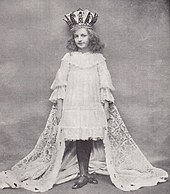
- Alice in Concert (1980), also known every bit Alice at the Palace, was a product written and produced past Elizabeth Swados. Performed on a bare stage, the production starred Meryl Streep in the role of Alice, with additional supporting cast by Marker Linn-Bakery and Betty Aberlin.
- Lookingglass Alice (2007) was an acrobatic estimation of both novels, produced by the Lookingglass Theater Company, that performed in New York City, Philadelphia, and Chicago,[36] with a version of the testify touring the rest of the United States.[37]
- A ii-role production by Iris Theatre in London was staged in the summer of 2013, in which the 2d part consisted of Through the Looking-Drinking glass. Both parts included Laura Wickham in the role of Alice.[38]
- Alice (2010), written by Laura Wade, was a modern adaptation of both books that premiered at the Crucible Theatre in Sheffield in 2010.[39]
- Wonder.country (2015), a live musical by Moira Buffini and Damon Albarn, takes some characters from the second novel, notably Dum and Dee and Humpty Dumpty, while the Queen of Hearts and the Cerise Queen are merged into i character.
- Alice in Wonderland and Through the Looking-Drinking glass (2001) was a stage adaption past Adrian Mitchell for the Royal Shakespeare Company, in which the second act consists of Through the Looking-Glass. [38]
- Alice's Adventures Under Ground (2020), a 1-human action opera written in 2016 by Gerald Barry and first staged at the Imperial Opera House, is a conflation of the two novels.[40]
- Looking-Glass, a 1982 Off-Broadway play based on Charles Dodgson, the real-life name of writer Lewis Carroll [41]
Other [edit]
- Jabberwocky (1977) is a film that expands the story of the poem "Jabberwocky".[42]
- Thru the Mirror (1936) is a Mickey Mouse short film in which Mickey travels through his mirror and into a bizarre world.
- Donald in Mathmagic Land (1959) is a moving-picture show that includes a segment with Donald Duck dressed as Alice meeting the Ruby-red Queen on a chessboard.
- American McGee's Alice (2000) is a figurer game in which the player takes the part of a teenage Alice fighting to reclaim her sanity. It was followed by a sequel, Alice: Madness Returns, in 2011.
- Through the Looking-Glass (2011) was a ballet past American composer John Craton.
- Through the Zombie Glass (2013) is a volume by Gena Showalter.
Encounter also [edit]
- Alice Chess
- "I Am the Walrus"
- Translations of Alice's Adventures in Wonderland
- Translations of Through the Looking-Drinking glass
- Vorpal sword
- Works based on Alice in Wonderland
References [edit]
Footnotes [edit]
- ^ During the "Mad Tea-Party", Alice reveals that the date is "the fourth" and that the month is "May" (chap.7).
- ^ In the kickoff chapter, Alice speaks of the snow outside and the "bonfire" that "the boys" are edifice for a commemoration "to-morrow," a clear reference to the traditional bonfires of Guy Fawkes Night that have identify on 5 November. In Chapter 5, she affirms that her age is "seven and a one-half exactly."
- ^ See "Jabberwocky" full poem including readings, via Wikisource.
- ^ See "Walrus and the Carpenter" full verse form, via Wikisource.
Citations [edit]
- ^ Oxford Companions. 1986. Oxford Companion to English Literature (5th Ed.).
- ^ Carroll, Lewis (1997). Lewis Carroll'southward Diaries: Containing Journal viii, May 1862 to September 1864. Lewis Carroll Society. p. 186.
- ^ Carpenter, Humphrey (1985). Secret Gardens: The Gilded Historic period of Children'due south Literature. Houghton Mifflin. p. 68. ISBN978-0-395-35293-nine.
- ^ Downey, Glen (1992). Theoretical Checkmating: an Analysis of the Fashion in which the "Chess Problem" in Through the Looking-Drinking glass Resists and Subverts Disquisitional Interpretations of the Novel's Chess Motif (PDF) (MA). McMaster University. p. 66 (.pdf p. 73).
- ^ Downey, Glen (1998). "3" (PDF). The Truth almost Pawn Promotion: The Development of the Chess Motif in Victorian Fiction (PhD). Academy of Victoria.
- ^ Hooper, David; Whyld, Kenneth (1996) [first pub. 1992]. The Oxford Companion to Chess (second ed.). Oxford: Oxford Academy Printing. ISBN0-19-280049-3.
- ^ Melt, Eleanor (2006). Enigmas and Riddles in Literature. New York: Cambridge University Press. ISBN 0521855101. p. 163.
- ^ Almossawi, Ali. "An Illustrated Volume of Bad Arguments". pp. 16–seven. Retrieved 15 June 2019.
- ^ a b c d e f g h i j k Carroll, Lewis. 1897 [1872]. Through the Looking Glass and What Alice Institute There. Philadelphia: Henry Altemus Visitor.
- ^ Bedtime-Story. 1999. "The Background & History of 'Alice in Wonderland'" Bedtime-Story Classics. Retrieved 29 Jan 2007.
- ^ Symon, Evan V. (eighteen June 2014) [2013]. "10 Deleted Chapters that Transformed Famous Books". Listverse.
- ^ Gardner, Martin (2000). The Annotated Alice. W. West. Norton & Company. p. 283. ISBN978-0-393-04847-6.
- ^ University Libraries. "The Wasp in a Wig: A 'Suppressed' Episode of Through The Looking-Glass and What Alice Found There" [exhibit item]. Alice 150 Years and Counting…The Legacy of Lewis Carroll. University of Maryland Libraries.
- ^ Gardner, Martin. (1990) More Annotated Alice. New York: Clarkson N. Potter. ISBN 0-394-58571-two.
- ^ Carroll, Lewis (1977). The Wasp in a Wig: A Suppressed Episode of 'Through The Looking-Glass and What Alice Found There. New York: Lewis Carroll Guild of North America.
- ^ Leach, Karoline (2015). "The Curious Case of the Wasp in the Wig" (PDF). Contrariwise . Retrieved 17 January 2019.
- ^ Alice Through a Looking Glass (1928) at IMDb
- ^ Cleverdon, Douglas (1959). Alice Through the Looking Drinking glass [sound recording]. Written past Lewis Carroll (1872). London: Argo. Retrieved via National Library of Australia and Archived on 10 April 2020.
- ^ Handley, Alan. 1966. Alice Through the Looking Glass, with music by M. Charlap, lyrics by E. Simmons. U.s.a.: NBC. TV special. Run into Alice Through the Looking Glass (1966) at IMDb.
- ^ "Alice Through the Looking Glass – 1966 Television Soundtrack." Masterworks Broadway. Runway listing.
- ^ MacTaggart, James. 1973. Alice Through the Looking Glass. Uk: BBC. Television special. See Alice Through the Looking Glass (1973) at IMDb.
- ^ Pruzhanskiy, Yefrem. 1982. Alice in the Country in the Other Side of the Mirror. RU: Kievnauchfilm. Retrieved from Animator.ru.
- ^ Bresciani, Andrea, and Richard Slapczynski. 1987. Alice Through the Looking Glass. AU: Burbank Films Australia. See Alice Through the Looking Glass (1987) at IMDb.
- ^ Henderson, John. 1998. Alice Through the Looking Drinking glass. United kingdom of great britain and northern ireland: Projector Productions and Channel four. Run into Alice Through the Looking Drinking glass (1998) at IMDb.
- ^ Burden, Andy (dir.). Alice Through a Looking Glass [live production], written by H. Naylor, music by P. Dodgson. Factory Theatre: Tobacco Manufacturing plant Theatres.
- ^ Upton, Andrew. 2008. Through the Looking Glass [opera], composed by A. John. Malthouse Theatre: Victorian Opera.
- ^ Wyatt, Stephen. 2011. "Lewis Carroll - Alice Through the Looking Glass" [radio broadcast], Saturday Drama. UK: BBC Radio 4. Retrieved via BBC Radio on ten April 2020.
- ^ McLeod, Norman Z. 1933. Alice in Wonderland. The states: Paramount Pictures. [Move picture]. Encounter Alice in Wonderland (1933) at IMDb.
- ^ Geronimi, Clyde, Wilfred Jackson and Hamilton Luske. 1951. Alice in Wonderland. US: Walt Disney Studios. Encounter Alice in Wonderland (1951) at IMDb.
- ^ Alice'south Adventures in Wonderland (1972) at IMDb
- ^ fictionrare2 (29 September 2014), Nel mondo di Alice 3^p, archived from the original on 11 December 2021, retrieved 23 Apr 2016
- ^ Alice in Wonderland (1985) at IMDb
- ^ Alice in Wonderland (1999) at IMDb
- ^ Alice (2009) at IMDb
- ^ Alice in Wonderland (2010) at IMDb
- ^ "Lookingglass Alice Video Preview". Lookingglasstheatre.org. Archived from the original on 27 October 2011. Retrieved v November 2011.
- ^ "Lookingglass Alice | Lookingglass Theatre Visitor". Lookingglasstheatre.org. 13 February 2007. Archived from the original on viii March 2012. Retrieved 16 January 2012.
- ^ a b "Theatre adaptations (excluding reimaginings)". all-in-the-gilded-afternoon96.tumblr.com . Retrieved 23 April 2016.
- ^ Wade, Laura. 2012. Alice. Oberon Modern Plays. Oberon Books. ISBN 9781849433570. [Theatre script]. Retrieved via Google Books.
- ^ "Alice's Adventures Under Footing". Royal Opera House . Retrieved half dozen February 2020.
- ^ Corry, John (fifteen June 1982). "Theater: Wonderland Characters in 'Looking-Glass'". The New York Times.
- ^ Jabberwocky (1977) at IMDb
Other sources [edit]
- Tymn, Marshall B.; Kenneth J. Zahorski and Robert H. Boyer (1979). Fantasy Literature: A Core Drove and Reference Guide . New York: R.R. Bowker Co. p. 61. ISBN978-0-8352-1431-5.
- Gardner, Martin (1990). More Annotated Alice . New York: Random House. p. 363. ISBN978-0-394-58571-0.
- Gardner, Martin (1960). The Annotated Alice. New York: Clarkson N. Potter. pp. 180–181.
External links [edit]
- Online texts
Source: https://en.wikipedia.org/wiki/Through_the_Looking-Glass
0 Response to "Y Tho Reddit Baby Looking Through Prism Glass"
Post a Comment